Before it became Valencia’s great civic stage, Plaza del Ayuntamiento was a convent, a railway neighbourhood and the edge of a rather colourful quarter of the city. Its forgotten history is considerably more surprising than the square looks today.
If you stand in the middle of Plaza del Ayuntamiento today, it is tempting to think that this has always been Valencia’s natural centre: a vast urban stage surrounded by grand façades, flower stalls, cafés, traffic and, every March, the deafening theatre of the Fallas mascletà.
But the old Plaza del Ayuntamiento Valencia was not really a square at all.
Its story begins with a religious building rather than a civic one. In the thirteenth century, following the Christian conquest of Valencia, land outside the city walls was granted to the Franciscan order for a convent dedicated to San Francisco. Over the centuries the city expanded around it, eventually swallowing the convent into the urban fabric. After the nineteenth-century confiscation of church property, the former religious complex was converted into a cavalry barracks. By the end of the century it was in poor condition, and in 1891 the entire complex was demolished.
That demolition created something Valencia had not previously possessed there: a large open urban space.
And, rather unexpectedly, the story becomes one of trains, cafés, fishermen and writers.
Valencia’s railway once came almost to the square
One of the least obvious facts about today’s Plaza del Ayuntamiento is that the area was once closely associated with Valencia’s first railway station.
In 1852, the first railway station serving the city was built close to the southern side of what would eventually become the square. The railway connected Valencia with the port area of El Grao, and for a time the railway literally brought travellers into what was still an evolving part of the city centre. The station was eventually demolished in 1920, but its presence helped push the area towards becoming an important urban and commercial centre.
Today, when visitors photograph the Ayuntamiento, Correos or the flower stalls, there is little to suggest that locomotives once helped define this part of Valencia.
The square itself developed gradually after the convent disappeared. A landscaped garden known as the Parque de Castelar was created on part of the former convent site, complete with sculptures by Mariano Benlliure. Meanwhile, the municipal authorities began imagining something considerably grander: a monumental central square that could compete with the great civic spaces of other European cities.
But creating that grand square meant clearing away another piece of Valencia.
The neighbourhood that disappeared
The transformation involved the old fishermen’s quarter, an area that occupied land around what is now the central city. Municipal plans for the new square and its surrounding streets involved the removal and redevelopment of the neighbourhood, alongside the creation of the streets now known as Correos and Lauria.
It is one of those details that changes the way you look at the square.
What appears today to be a carefully planned monumental centre was actually produced through a series of demolitions, clearances and urban decisions that radically altered the social geography of Valencia.
And the old neighbourhood was not exactly a sleepy corner of town.
The nearby Bajada de San Francisco became known for cafés, restaurants and nightlife. Among them was the spectacular Café España, opened in 1885 and decorated in an elaborate oriental style, with high ceilings, arches, columns and paintings by artists including Pinazo, Sala, Cortina and Agrassot. It was the kind of establishment where Valencia’s cultural and political elite could rub shoulders over coffee, music and conversation.
Azorín, the celebrated Spanish writer from nearby Monòver, was impressed enough to write that there was “ningún cafetín tan suntuoso ni en Valencia ni en París” — no café so sumptuous in either Valencia or Paris.
That is quite an endorsement from a man who had presumably seen a few cafés.
Hemingway arrived before the tourist brochures did
There is another delicious connection between this vanished world and one of the twentieth century’s most famous writers.
In 1925, Ernest Hemingway came to Valencia. He was still a young writer at the time, travelling to Spain during the July festivities and bullfighting season. He stayed in the area around the city centre and became fascinated by Valencia’s combination of heat, food, bullfighting, nightlife and Mediterranean life. Contemporary accounts place him around the Bajada de San Francisco area, while the city has subsequently incorporated several of his Valencia locations into a Hemingway route.
Hemingway later remembered Valencia in Death in the Afternoon, describing the city’s heat, its journey to El Grao and the beach restaurants where visitors could eat paella and drink local wine.
His description is wonderfully un-touristy. He wrote:
That is Hemingway doing what Hemingway did best: making the weather sound like a physical opponent.
The connection is particularly interesting because Hemingway’s Valencia was not the polished postcard city we know today. He encountered a city still in the process of modernising, where old neighbourhoods were disappearing and grand new civic spaces were being created.
Old Plaza del Ayuntamiento Valencia: A square with a surprisingly political past
The square also acquired a remarkable political history.
Its names changed repeatedly. It had been known as Plaza de San Francisco, then Plaza del General Espartero, Plaza de Isabel II, back to San Francisco, and eventually Plaza de Emilio Castelar. During the Franco dictatorship it became Plaza del Caudillo. After the dictatorship it was renamed Plaza del País Valenciano, before finally becoming Plaza del Ayuntamiento in 1987.
So the name on an old photograph of the square can tell you roughly when the photograph was taken.
And then came one of the most extraordinary episodes in its history.
When Valencia became the capital of the Second Spanish Republic between November 1936 and October 1937, the square was still known as Plaza de Emilio Castelar. The Ayuntamiento became the official headquarters of the Republican Courts, and the building hosted parliamentary sessions during the Civil War. The area was also affected by the bombing of Valencia, and the Town Hall itself contains an air-raid shelter capable of accommodating more than 700 people.
The glamorous square of cafés and grand architecture suddenly found itself at the centre of national politics and a European war.
That history is still physically there, even if most visitors never notice it.
From railway edge to Valencia’s great civic stage
By the early twentieth century, the authorities were determined to turn this once rather peripheral area into a monumental centre. The new Ayuntamiento façade, the Correos building and the surrounding architecture helped establish the square as one of the city’s principal public spaces. Later urban interventions, particularly those associated with municipal architect Javier Goerlich, radically changed its appearance again.
That is perhaps the most interesting thing about Plaza del Ayuntamiento.
It isn’t ancient in the way the Lonja, Cathedral or Torres de Serranos are ancient. The square is comparatively young. What makes it historic is the extraordinary number of different Valencian cities that have existed on this same patch of ground.
There was the city of the Franciscans. The city of the cavalry barracks. The city of the railway. The city of the fishermen and cafés. The modernising city of the early twentieth century. The republican capital. The dictatorship’s Plaza del Caudillo. And finally the democratic Plaza del Ayuntamiento.
One place, several Valencias.
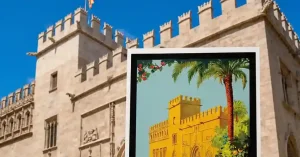
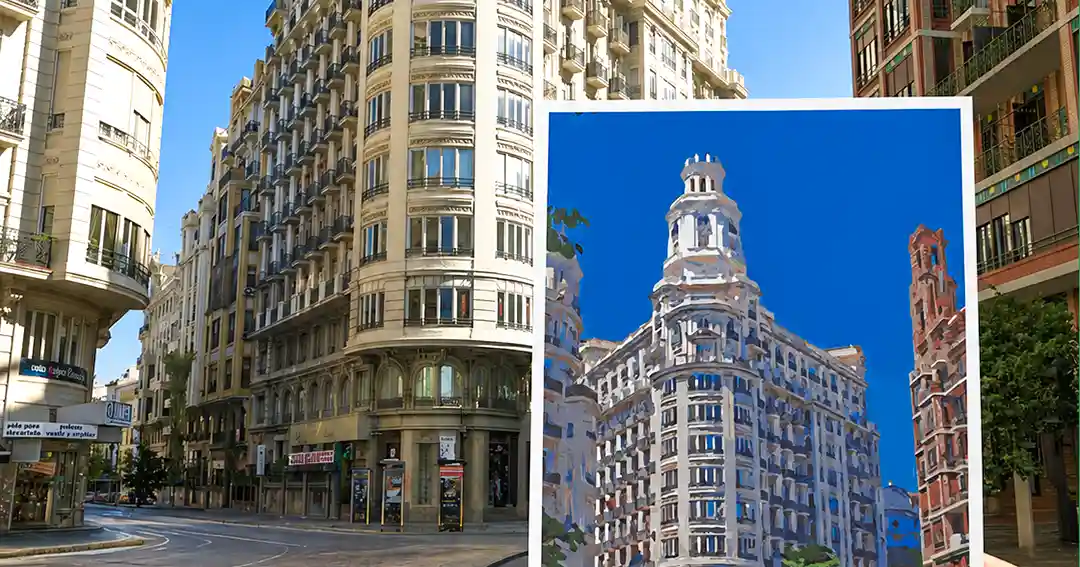
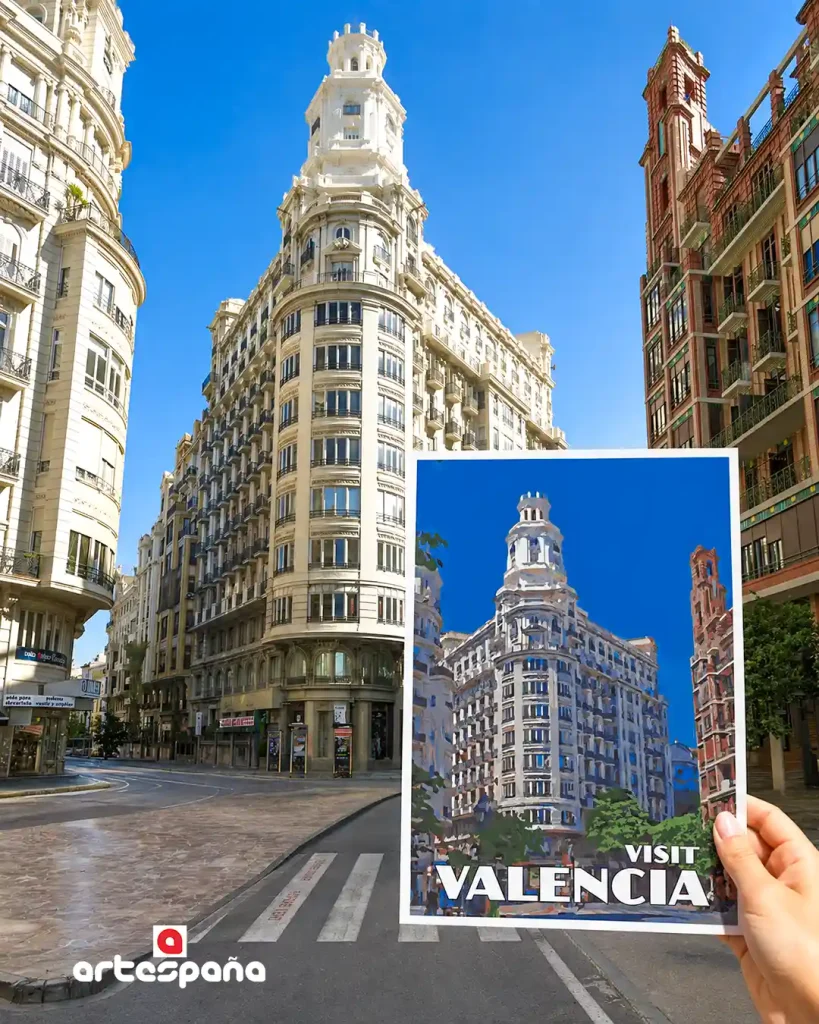
That is also why a vintage poster can be surprisingly revealing when placed against the real architecture. A poster is not simply an illustration of a building; it is an interpretation of how a city wants to be remembered. The Artespana image used here deliberately plays with that idea, placing an artistic representation of Valencia against the physical city itself.
The comparison is almost a historical conversation: this is what Valencia was, this is what Valencia became, and this is how we choose to remember it.
And perhaps that is the real secret of the old Plaza del Ayuntamiento Valencia. Its history is not hidden because the buildings are difficult to see. It is hidden because the square looks so confidently modern.
Underneath that confidence are a demolished convent, a vanished railway station, a neighbourhood that disappeared, extravagant cafés, political battles, air-raid shelters and the footsteps of one very young Ernest Hemingway.
Not bad for a square.
© Old Plaza del Ayuntamiento Valencia: The Forgotten Stories – Artespana.es
Get some more stories like Old Plaza del Ayuntamiento Valencia