Discover the remarkable life of an artist whose work captured the soul of a changing nation and a rising Valencian identity.
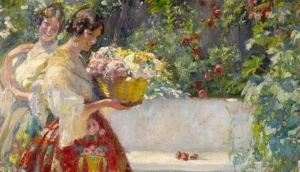
The history of Valencian art in the early 20th century is incomplete without the prolific and sensitive contributions of Antonio Vercher Coll. Born in the city of Valencia on January 17, 1900, he emerged from a family deeply rooted in the local craft traditions. He was the son and brother of fan painters, an occupation that demanded extreme precision, a delicate touch, and an innate sense of decorative harmony. This early exposure to the meticulous world of fan painting likely sparked his lifelong interest in the visual arts, leading him to pursue formal training at the prestigious Escuela de Belles Arts de Sant Carles. Entering the academy in the late 1910s, he quickly distinguished himself among his peers. His technical skill and artistic sensitivity were recognized early through various academic honors, most notably the Premi Roig, which he was awarded in both 1925 and 1926. These early successes set the stage for a career that would see Antonio Vercher Coll become one of the most influential illustrators and painters of his generation.
The Golden Age of Valencian Illustration and Graphic Press
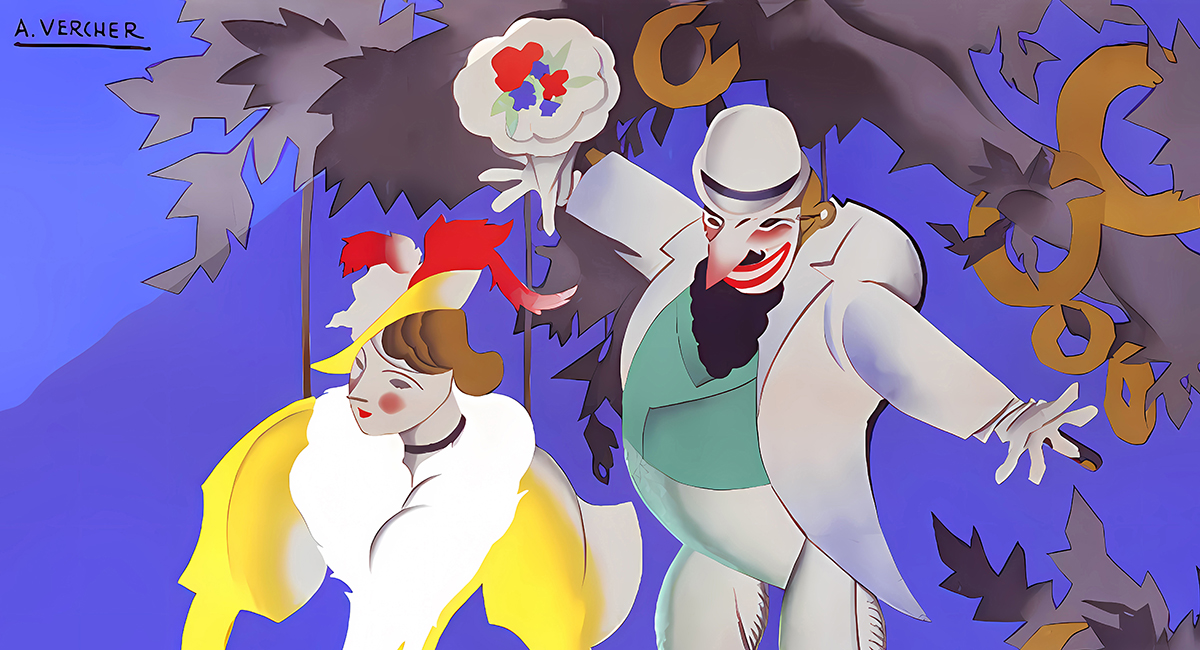
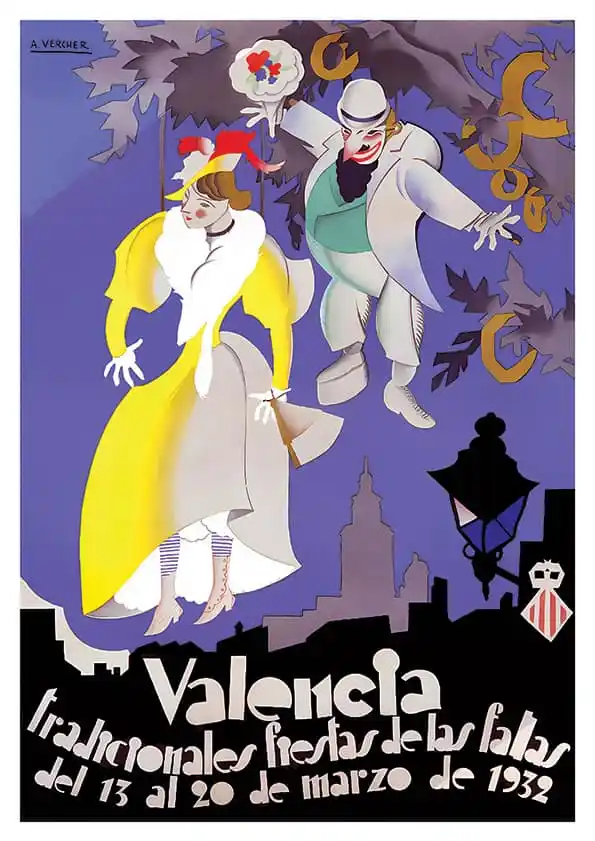
While Antonio Vercher Coll was a skilled painter, he achieved his greatest public resonance as a master of the graphic press. During the first third of the 20th century, Valencia experienced a “golden age” of illustration, and Vercher was at its very center. He became a celebrated caricaturist, contributing his sharp yet sensitive observations to numerous iconic Valencian periodicals, including Las Provincias, El Cuento del Dumenche, El Folletín, El Pardalero, and Pensat i Fet. However, his most definitive work was arguably for the magazine Semana Gráfica. Within its pages, Antonio Vercher Coll served as the quintessential illustrator, responsible for a vast array of covers, vignettes, caricatures, decorative borders, advertisements, and even early comic strips.
At Semana Gráfica, Antonio Vercher Coll worked alongside other fundamental figures of the Valencian artistic renewal, such as Josep Renau, Lluís Dubon, and Amadeu Roca. Together, this group of artists conferred a distinct Art Déco aesthetic upon the publication, marking a shift toward modernity in the region. Vercher’s influence also extended to the literary sphere through his involvement with Nostra Novel·la, a popular literary magazine that aimed for greater orthographic rigor and modern visual appeal. His drawings for this publication, along with those of artists like Maria Labrandero and Manolita Ballester, gave the magazine a stamp of contemporary sophistication.
Beyond commercial illustration, Antonio Vercher Coll was deeply involved in the Valencianist cultural recovery. He was a key contributor to Taula de Lletres Valencianes, a crucial magazine dedicated to the purification of the Valencian language and the promotion of a distinct regional identity. His work here was not merely decorative but was part of a broader effort to elevate Valencian culture to a modern, European standard. This commitment to his heritage was also seen in more traditional projects, such as his 1921 design for the Auca, bunyol o pastís del dia de Sent Donís for the Societat de Pastissers de València, which featured verses by his friend and admirer Francesc Almela i Vives.
A Marriage of Arts: The Partnership with María Labrandero
In October 1929, the personal and professional lives of Antonio Vercher Coll reached a significant milestone when he married the talented sculptor María Labrandero García. The couple had met in their local neighborhood and during their shared years of training at the Escuela de Belles Arts de Sant Carles. Their union was hailed by the press as a “Boda de artistas” (Wedding of Artists), and they held their ceremony at the altar of San José in the parish church of San Juan and San Vicente on November 18, 1929. Their artistic synergy was immediate; that same year, they held a joint exhibition at the Sala Abad on Pintor Sorolla street, demonstrating how their different mediums—painting and sculpture—could complement one another.
Following their wedding, the couple embarked on an artistic honeymoon that took them through Barcelona and several cities in France and Belgium, allowing them to absorb the latest international trends in European art. Upon their return, they established a home that functioned as a shared artistic laboratory. This partnership was not just domestic but deeply collaborative; for instance, Antonio Vercher Coll and María Labrandero both contributed drawings to the magazine Nostra Novel·la. Their home became a space where they could foster each other’s creativity, with María Labrandero often serving as the first custodian and critic of Antonio Vercher Coll’s evolving work.
The couple was also active in the vibrant social and intellectual circles of Valencia. Antonio Vercher Coll was one of the artists who exhibited at the Sala Blava, a gothic house with blue walls that opened in June 1929 and became a major hub for intellectuals and the headquarters of the Agrupació Valencianista Republicana. His involvement with this group continued into the early 1930s, as he participated in the “III Manifestació d’Art” in January 1933. This collective exhibition emulated the art fairs of Barcelona, allowing the public to interact with the works and even purchase drawings from the artists’ portfolios, a move that highlighted Vercher’s desire to make art more accessible to the general public.
Political Commitment, Premature Death, and Modern Homages
Antonio Vercher Coll was more than just an artist; he was a man of deep convictions. According to his contemporary, Manuel González Martí, Vercher was a standout figure of the modern Valencian generation who was deeply committed to social and political causes. He was described by Francesc Almela i Vives as “profoundly Valencianist,” a man who yearned for “broad freedom for all men.” This political outlook was coupled with a strong admiration for Catalonia, whose art, politics, and daily news he followed closely. He was a regular reader of the magazine Art and various Catalan newspapers, seeking to understand the cultural and political developments of his neighbors. He saw the movement for regional identity as an essential part of the broader push for a modern, democratic, and culturally enriched society.
His promising career and family life were tragically cut short in September 1934. At the young age of 34, and just as he was about to become a father for the second time, Antonio Vercher Coll died from typhoid fever. His sudden passing was a major loss to the Valencian artistic community, which mourned the silencing of one of its most versatile and promising voices. His widow, María Labrandero, took on the passionate role of the custodian of his legacy, ensuring that his work was preserved and remembered. In 1958, she donated one of his significant works, Mujeres de Paterna, to the national collections. Today, they rest together in the General Cemetery of Valencia, under a tombstone designed by María herself, bearing the inscription: “Ofrena a la pau de ma vida” (An offering to the peace of my life).
The legacy of Antonio Vercher Coll continues to resonate in the 21st century. In December 2025, the Falla Tio Pep (Reina – Paz – San Vicente) paid a unique urban tribute to him to mark the 125th anniversary of his birth. The commission reproduced one of Vercher’s most iconic drawings—a 1925 cover for a falla llibret—onto the shutters of their social club (casal) on Embajador Vich street. This specific drawing is historically significant because it was the first time the name “Tio Pep” was used, which later became the nickname for the commission itself. Under the artistic direction of Sofia Regidor Porcar, this intervention ensures that the vibrant, modern, and deeply Valencian spirit of Antonio Vercher Coll remains visible to the citizens of the city he loved and captured so vividly in his art.
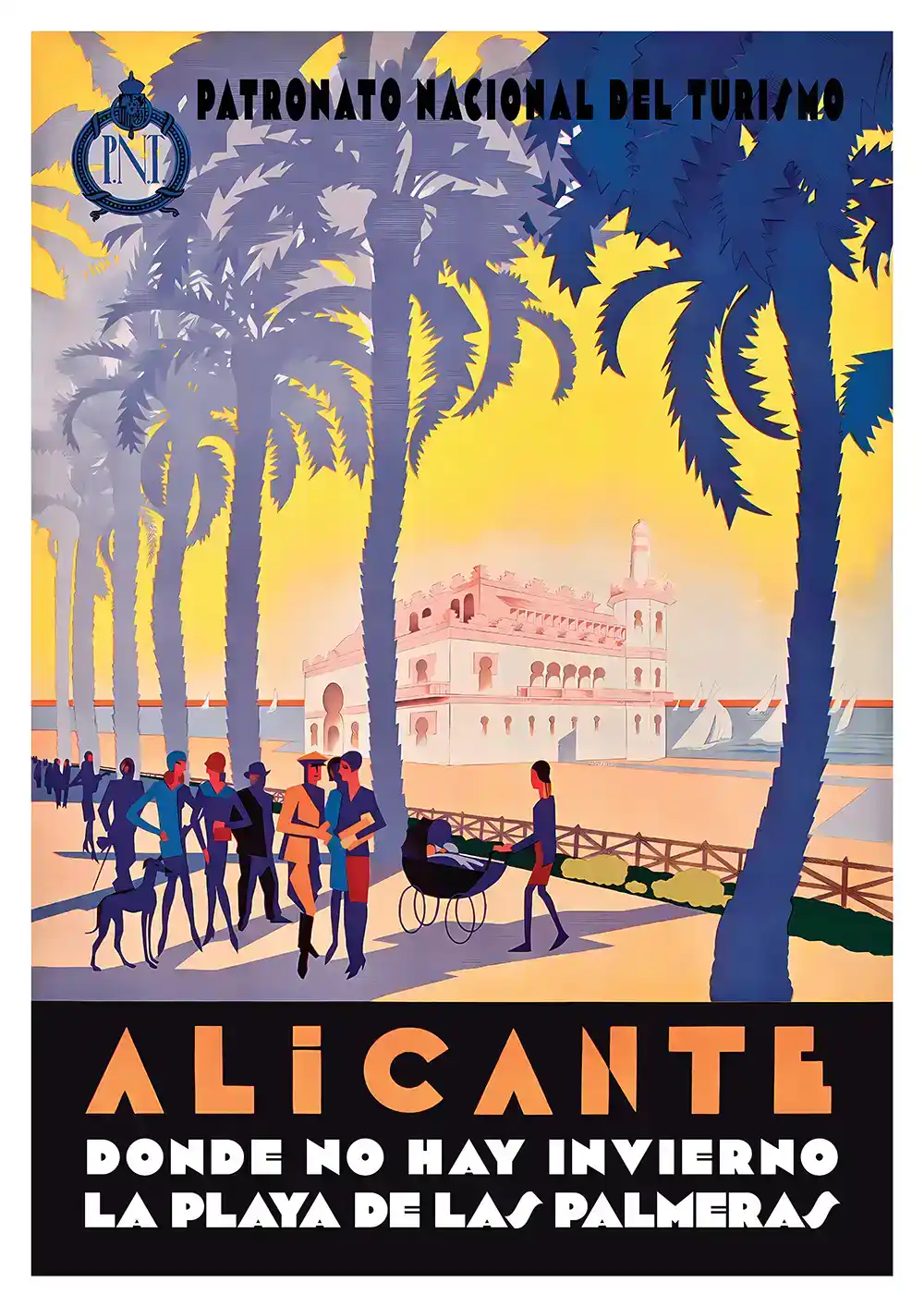
His contributions to the Patronato Nacional de Turismo also remain a point of historical interest. Vercher was commissioned to design posters for the Levante and Alicante regions, contributing to the first major national effort to promote Spanish tourism during the late 1920s and early 1930s. Although these campaigns were later hampered by the financial crisis of 1929 and the subsequent civil unrest, Antonio Vercher Coll’s posters are now regarded as masterpieces of tourism graphic art, showcasing his ability to distill the essence of a landscape into a single, compelling image. Whether through a magazine cover, a political exhibition, or a tourism poster, the work of Antonio Vercher Coll serves as a permanent window into the dynamism of Valencian modernity and the enduring power of Art Déco.
© Antonio Vercher Coll: The Pulse of Valencian Art Déco – Artespana.es
Get some more Articles like Antonio Vercher Coll